Showing posts with label sport. Show all posts

Monday, 13 January 2014

"I really wanted an autograph": The story of how a Manchester United fan got to work with his heroes when they visited Sydney last year

A medical student at the University of Sydney, Zarshis Avari was part of the medical team that was attached to Manchester United when they travelled to Australia for their pre-season preparations last summer.

Zarshis has been supporting Manchester United for the last ten years, but he's wearing a frown while speaking about them now.

He's speaking to me a day after Sunderland beat the Red Devils at the Stadium of Light in the first leg of the Capital One Cup semi-final, but that United have suffered three defeats on the bounce does not dampen his enthusiasm when he tells me about what he did last summer.

Zarshis Avari, medical student and
Manchester United fan.
Reproduced with permission

How it happened


Although he now cherishes the week he spent with the United players and staff, his time with the 21-time Premier League champions happened by chance.

"It was a part of my Independent Learning Assignment (ILA)," he recalls "I went to the Sports Science Association and I asked the receptionist, 'can I see any doctor who's available and who can take me in for a week or two?' 

He walked in to the association building about three months before United came calling. For legal reasons, Zarshis does not wish to name the doctor who'd organised this for him.

The doctor said 'I'm going to be busy for the next three to four weeks because a team from England is coming to play in Sydney and I will be their physio while they're in Sydney.'

'Which team are we talking about here?' was Zarshis' next question, because he - rabid fan that he is - knew United were coming to Sydney.

"He didn't even know the name of Manchester United and he looks at his phone," recalls Zarshis, giving me the same wide-eyed stare he gave this doctor when he came to know that he was going to be working with United.

His love for United


"I just go, 'look, please, can I please please please please (four pleases) do my ILA with you on this topic because I'm a big, big fan and he straight away pointed out that being a fan, it's not a good thing because you have to keep your opinion and your profession separate," he recalls.

This was a chance that most football fans would give anything to be part of, and Zarshis had to promise to be on his best behaviour when the team did come to Sydney if he was to convince this doctor to let him work with him.

Lookie, lookie! From left to right: Manchester United's Anderson Oliveira, David de Gea, Rafael da Silva and Patrice Evra along with two members of the coaching staff at the $1000 a night Park Inn hotel where the players stayed.
Reproduced with permission
A month later, Zarshis was given his entry pass, but it came with strict conditions.

"No autographs, no photos, no handshakes," is what the doctor told Zarshis. "You'll be tailing me, you'll only be with the players while I'm there."

Fan that he is though, Zarshis went to see his childhood heroes disembark at Sydney International Airport and was even able to take a few photos of them.

"I always thought I wouldn't have much of a reaction because I'm that kind of guy but seeing the legends like Ryan Giggs and Paul Scholes, that was huge," he recalls.

But when he joined up with the team the next day at the Kogarah Stadium, he remembers having to restrain that emotional side of himself.

Staying grounded


"When I was with the team, it was hard," he says. "I was thinking about the goals that (Wilfried) Zaha has scored or the goals that Ryan Giggs has scored, I was thinking about the FA Cup (semi-final) against Arsenal.


"Sometimes I would tend to forget what I had to do so I would just stare at the player in a blank fashion. The player would know what was going on because they've seen that reaction a lot of times."

"I really wanted an autograph!" he adds wistfully. "I was even thinking of sneaking in but my professional side told me 'you might get thrown out'."

One of the tests Zarshis remembers doing on the players was a knee exam on Patrice Evra, but a few musculoskeletal tests aside, he spent most of his time tailing his physio.

On the 20th of July, Zarshis added to that experience when he watched his beloved team play live for the first time at the ANZ Stadium. The pre-season friendly between United and the Australian A-League All Stars ended in a thumping 5-1 win for the visitors.

Fond memories: Zarshis' photo of the two teams lining up in the ANZ Stadium at the Sydney Olympic Park ahead of their pre-season friendly. United won 5-1 with a brace apiece from Danny Welbeck and Jesse Lingard, with Robin van Persie also scoring. Reproduced with permission
During their stay in Australia, the United players hosted several autograph-signing sessions but Zarshis could not attend them because in addition to working with the team, he still had to attend lessons and prepare for his exams.

"I had an exam the week after, so I could really take time out to go to the Kogarah stadium to meet the players," he says.

Unfortunately, Zarshis has had  to look for another ILA, which he tells me has already been secured: because his time with the team was so short, it did not count towards the completion of his ILA.

Truth be told, I don't think he really minded. "It was an amazing experience, just seeing the players in real life," he gushes.

"Working with them, it's going to go on my CV and I'm betting it's going to impress a few employers."

Sunday, 29 December 2013

Oman to have Middle East's first sports science course

The Modern College of Business and Science in Muscat, Oman is set to launch the Middle East's first ever sport science programme. 

This course will be held in association with the Trafford College of Manchester in the United Kingdom, global non-profit football development organisation Kick Worldwide and the Oman Football Association (OFA) and is set to launch by September 2014.

Professor S.K. Pemma Raju, Director, Centre for Graduate and Professional Studies, Modern College of Business and Science. Reproduced with permission.
"Initially, we want to bring in sports-related programmes in a way to develop some activity in the youth," says Dr. S.K. Pemma Raju, the College's Director for Graduate and Professional Studies.

"It's not an organised way in which these sports have been [organised] particularly in terms of football, though the OFA is there. I think from six months back these guys (the OFA) have started giving proper training."

"Mostly the demand is for football," explains Dr. Raju. "That is the main thing, so we're starting with football and a couple of enquiries came for tennis.

Related Article: Q&A session with Chuck Martini, Head Coach, Muscat Football Academy

"Here, we don't have activities for the women," he adds. "Our other idea is to bring the Omani women into the sports field to provide them special facilities to do these things and a couple of girls are interested in trying to learn tennis to make their career. We are encouraging [them] on both sides."

Qatar 2022


One of the reasons the College - which has an affiliation with the University of St. Louis in the United States - has decided to invest in a sports science programme is because Qatar has won the rights to host the 2022 FIFA World Cup, which has given sports in the Middle East a major boost.

Related article: Football development in the Middle East shows global popularity of the sport

Dr. Raju hopes that by that time the World Cup does come to the Arab world, Oman will have sports science professionals who will be on hand to assist teams that make it to Qatar 2022.

"Now we want to start something related to some courses relating to the coaching and the refereeing, particularly keeping the sports activities that are going to take place in Qatar," he says.

"Already, Kick Worldwide has started some sports activities in some interiors with school kids."

Between one and two thousand kids took part in those activities, and Dr. Raju says that the next segment of the organisation's target audience is the youth who are in the later years of school life, so that they can begin to train the next generation of adults at foundation level.

"We want them to become professionals in the longer run," he says. "[We will] provide them proper direction, give them proper coaching."


Link-up


On completion of this short-term course, students will get certificates that are jointly issued by the OFA and the Ministry of Manpower.

"They get a qualification and they do a couple of units here which has a direct link for the Associate or Bachelors' programmes anywhere in the world," explains Dr. Raju. "They complete here, certain of the courses.

"This will have a link-up with the advanced modules in certain other countries so guys who want to pursue their higher education in sports, the courses [that] they do here, they can be transferred. That is the main idea."

Those who wish to have a career in sports will also benefit from this course, which will have 40% theoretical studies with the other 60% being practical in nature. Holders of this certificate can join schools as sport coaches and will be called upon to officiate local league football games.

Plans are under way to develop an AstroTurf football pitch at the College for practical purposes. Although the course now only offers a sports science qualification in football, Dr. Raju hopes that there will be other specialisations that prospective students can follow in the future.

"The real sports personalities, we would like to interact with them," he says. "In another way, what I can say is we want the trainers to train the trainers so let the real people who're on the field, the professionals impart their knowledge, their methods and all and we train the local talent.

"After sometime, possibly they can take over the training initiative," he adds. "That is the reason why we're trying with a good organisation, where they are already experienced in this field."


Educational hub


Dr. Raju hopes that this course will help make Oman an educational hub for such studies. "A strategic location would be Oman [because] it is a non-controversial and peaceful place so people can come down here and we want to make this as a centre, a hub of the entire Middle East."

"You don't have these sports related [courses], particularly with this line of thought: trying to offer and linking up these courses for further education if students are interested in sports careers."

"People now are [getting] convinced that sports can also become a career," explains Dr. Raju. "There are parents also now, seeing various ways of making their children's dream come true."

The College has plans to introduce an AstroTurf pitch on campus for the practical aspect of the course to be taught. Space for the same has already been allotted.
Photo for illustrative purposes only. Image courtesy Wikipedia. com. 
The College also has in place long-term plans for such courses, says Dr. Raju.

"This is the initial step and if we see that there's a lot of future for sports as a career - you about the football celebrities, how much they are making - we want to make it in an organised way, linking up with the Oman Football Association.

"With their patronage, possible, there will be a continuity of the game, the activities on one side and in future we would like to associate with other sports bodies so something can be done in a better way for sports as a career," he finishes.    

Tuesday, 3 December 2013

Following the growth of Bangladesh's first football academy

Ahmed Sayed Al Fatah's day begins at five in the morning. He is Director of his family business, Nandita Properties, a construction firm based out of his home town of Kushtia, Bangladesh.

But before and after work, Ahmed can be found on the sand flats next to his office, where he is building his pet project: Bangladesh's first ever football academy.

Ahmed Sayed Al-Fatah
Reproduced with permission
Located on the banks of the Gorai river, Kushtia is about 100 miles away from Bangladesh's capital Dhaka. It is on these banks that Ahmed has begun his football project.

"I have invented a new method & process of running [an] Economical Football Project for developing countries which is an economical way to run football training activities using existing resources with a minimum nutrition support for changing the poor society to achieve positive youth development," he tells me. 

Humble beginnings


It's not just development of football that Ahmed wishes to undertake: he wishes to do it while trying to eradicate poverty in his native country.

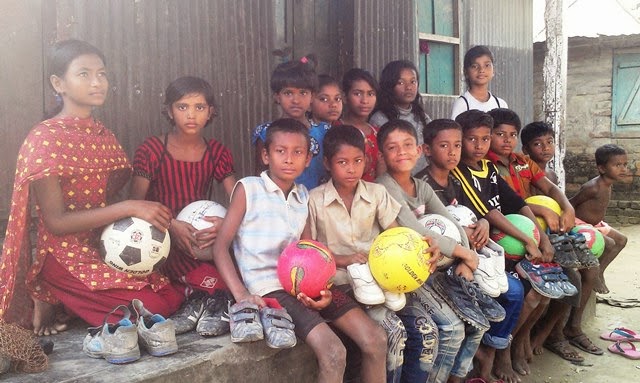
Living on the banks of the Gorai are some of Bangladesh's poorest families. It is from these families that Ahmed recruits the kids who are part of his academy. The parents of these children work as rickshaw pullers, tailors, daily wage labourers, fishmongers, janitors and painters.

Before joining his family business, Ahmed spent six years working as the Media and Communications Officer of the Bangladesh Football Federation and as a Regional Instructor for Football Administration and Management under FIFA. 

"I tried to use my football experience in rest of my life," he says. "Also, I wanted to do something which can bring good for people so [I] started [visiting] the poor area beside our office cum living space at Kushtia. 

"There I found no one playing any proper sport [on] their uneven field, so after observing for some days at their lifestyle, I went to the field with a football to encourage the older youth boys to play football as they couldn't afford a football," he adds.

Started in January 2013, Ahmed's project primarily targets boys and girls between seven and 13 years of age. Having no method to actually gauge how good the kids were, he would use running races to determine how speedy his potential trainees actually were.

Ahmed putting his charges through their paces. He uses the banks of the Gorai river for training them. Reproduced with permission.
"After some days, I announced that girls football will be organized, soon the sporting minded girls came out for play," says the 33-year-old. "After selecting some girls with good running ability, I went to their parents for motivating them to let [them] train with me. 

"Then I also [told] the parents that I [would] also take care of their education by giving them a personal study hour. Inspired by the girls learning the skills fast, I also started to add boys."

Ahmed says that the "main criteria for selecting kids are: poor kids but good at sports. I looked for various companies in the world who are all working in this sector [and] studied all the documents they published. Mainly, the Indian 'Magic Bus' concept inspired me a lot."

"We provide the poor kids with knowledge which are highly desirable benefits of a physically active lifestyle that contribute to competence in lifelong physical activities, attaining social and psychological life skills like interpersonal skills, resistance skills and improving developmental outcomes such as confidence, self-regulation, character, motivation, and perseverance," says Ahmed.

Logistics and training


Because of his association with the Bangladesh Football Federation, Ahmed is well aware that there are no football academies in his country. Football development schools that do exist are present only in name.

"For an academy, land, buildings [and] training facilities are a must," he says.

"The sandy riverside area is the main training facility and the training equipment are from various structures like abandoned half built bamboo house, cement blocks, staircases, cement slopes etc. which also reduces the cost of land, buildings [and] equipment," he explains. 

"All these are made by government and I can use it for free."

It is on these flats that Ahmed and his cousin teach these kids the art of performing stepovers, cuts and feints, as well as the more industrial elements of the game such as shooting, dribbling and tackling.

Because of his tenure in football administration, he has access to a large collection of DVDs which he uses to demonstrate skills to his potential graduates, in addition to performing them himself to show them how it is done.

Ahmed says he thought of developing his football academy in Kushtia after he found people who were enthusiastic about the sport. At first, they couldn't afford a football. Reproduced with permission
"A juice, a pack of biscuit, a boiled egg, and a banana is provided to each of the players after training which cost about $10 per day per head," Ahmed tells me.

"Sports shoes, boots, shorts, jerseys, sports bags, balls, guards etc. are provided step by step on overall progress of each player accordingly where one starts with bare foot and own gears without food. All this equipment is being earned/achieved by each player’s performances in each session.

"In the first month of training, a kid won't get any food or equipment but have to give me various tests to prove his stamina and strength both mentally and physically," explains Ahmed.

"Passing the first month, the kid will get new sports shoes for training. then passing the second month with regular presence in all of our activities she/he will get other equipment by showing progress in football training."

At present, it is his family business, Nandita Properties, that provides him with the funds he requires to procure the food and gear he provides these kids. He soon plans to convert this fledgeling set up into a non government organisation, which will allow him to seek funding from investors throughout the world.

Gaining recognition: his academy's proudest moment


One of the pupils Ahmed helped nurture is now playing for the Kushtia State Team. 13-year-old Nilufa Yeasmin, one of the first children he took into his fold, trained under him for six months before representing her school at a football tournament.

She was named the most skilful player of that tournament.

A month later, the district's selectors came calling. "She told me that there will be a selection at the district stadium, where her school wants to take for a football trial and again, I allowed her to go," says Ahmed.

"Then she got selected by the selectors of the district women footballers," he says.

"That was [the] greatest moment I'd ever enjoyed and [I] felt that my concept had started working," he exclaims.

"[The] reaction of the others at the camp was tremendous. They all became very excited and most importantly, [showed] their willingness to train for getting [into the] district team."


What comes next puts that into even greater perspective. Before the exploits of young Nilufa, Ahmed tells me he'd faced a lot of flak from different areas of society. 

'Why are you wasting your money and time after poor kids?,' they would ask. 'Hey look, a mad man is going who's spending his rich pockets' money,' they would say.

"I used to ask permission to each of the parents before involving the kids in my project. I used to motivate them, describe my purpose to develop the youth in a positive way," he recalls.

"I had to drop out some girls after some days of training for religious & social barriers. It took time [to gain] the confidence of the parents as it was an individual effort then."

That, however, is not the case any more.

"Later on, after project continued for [a] long time, then the parents started to believe in this concept," he continues.

"The parents in each month's feedback session informed [me] that the kids’ food habit increased, sleep time increased, study time increased, [they] became more active participants in their own families and social behaviour had been modified soon after they started training with us. 

"Nowadays, mostly poor girls [with potential] or mothers come to the training place and request [me] to include their kids too." I cannot help but smile as he tells me this.

In addition to just playing the sport, Ahmed makes it compulsory for his young players to devote time to study on a daily basis. Reproduced with permission
It's not just the parents of those he trains who feel this way. His own do too. "They are very excited and [have been] became [very] enthusiastic [about] my project from the very beginning," he says "They have always supported my dreams

"In this project my uncle is the main brainstormer for all success it already has (achieved)," he adds. "Now they have made a commitment to continue supporting this project at a reasonable scale for life."

Long-term plans


In 2014, Ahmed will apply to make his project a non government organisation, opening the doors to funding from various investors throughout the world.

"I will try to spread this concept countrywide through football federation or sports department of our government," he explains.

"After that, I want to make an ideal football academy to support the NGO."

Ahmed says he has good contacts with coaches in his country, so hiring them once he takes the next step in developing his academy will be easy. Because of his time in the administrative world of football, finding local sponsors will also not be a challenge for him.

He also aims to solve several problems that contribute to poverty by promoting an anti-drug attitude, increasing the living standard, empowering women and educating the poor society

"I involve other young kids in the afternoon at the field with various sporting activities which makes them tired," he says. "That prevents their tendency to go out in [the] evening or involve [themselves] in drugs has radically been decreased."

Training and academics aside, Ahmed is also teaching the children social responsibility. See here are the kids repainting sections of a wall. Reproduced with permission
"As the sports training takes out lots of energy, the eating habit of the kids, the habit of early rising and the sense of taking commands from superiors has been radically increased among the kids."          

He plans on improving youth participation in sports for positive development, increasing the standards of fitness and physical ability of youth from poor society and to increase the supply of standard football players specially women both locally & internationally.

"I will take eight years per player to build him/her as an international standard football player for sale to other countries or locally," says Ahmed. 

Ahmed believes in his vision. He also believes it will succeed. "Football is a universal language. All of the football stars in the world are from poor society and poor background. It changed their life," he says.

Related reading: Q&A with Chuck Martini, Head Coach, Muscat Football Academy