Showing posts with label academics. Show all posts

Friday, 10 October 2014

10 ways in which the internet has helped society

As part of the Enterprise module of my MA Online Journalism course at Birmingham City University, I am required to take a look at how the internet has helped changed society for the better.


Here are ten ways in which that has been achieved.

  • Voice-over Internet Protocol

Skype was probably the first mass-produced video-calling software that made use of the internet's Voice-over Internet Protocol (VOIP) system, and its quite clear that the technology is here to stay. Skype helps individuals keep in touch with families and friends over time periods that are far shorter that those employed by conventional methods of communication. 

Google too have entered the VOIP race with their Hangouts feature that is built into their email facilities. While both of these products are mass-produced, national mobile-phone service providers have also made this facility available to their customers.

One of the advantages of VOIP facilities is the fact that they're free, and everyone likes free stuff, yes? (or was that just me).

However, certain nations have also taken to blocking programmes such as Skype in order to promote their own more expensive VOIP services. The Sultanate of Oman, for example, has blocked the service on the account of it being against the "societal and cultural norms of the Sultanate".

Standard Block Site Management notice on websites blocked in the Sultanate of Oman.
These services are more expensive, and are at times barely affordable to migrant labourers in nations that need to use these services in order to speak to their families at home. A call from Oman to India, for example, where many of these labourers come from, is about 50 cents a minute using Omantel, Oman's national mobile service provider. 

They're only paid, however, about $250 a month, which would mean a significant portions of their salaries go towards VOIP services when the same could be accessed via an internet connection which, which most of them already have access to.

Moreover, while most people tend to own their own mobile phone(s), it is quite common for groups of people to jointly own and maintain an internet connection, which would further reduce costs incurred.

VOIP call rates issued by Omantel, Oman's national mobile telephony provider.

  • Faster journalism

The arrival of high-speed internet makes it extremely simple for journalists to conduct research which is oriented towards the stories they write. 

While digging up archives and going to the library to obtain information can sometimes be a time-consuming and painstaking task, the internet allows easy access to papers, articles and books that penned by people journalists would like to quote in their articles.

The internet has also allowed journalists to refer to other articles written on the same subject by journalists at different publications. This allows journalists to construct their own articles more quickly, assuming they wish to quote another article written by another journalist in their newspaper.

This practice is now commonly followed throughout the world, which means that news stories broken by one publication are now shared in a matter of hours the world over by other publications as well. 

In a world where online publications are dependant on the number of visitors that access their sites, this helps significantly increase the visits their sites would receive. In addition, while some might say that online publications can be accessed the world over, there is still a certain comfort zone that people maintain when it comes to finding sources of news. 

Most people would prefer their news coming from one publication than a host of different publications and to see a particular piece of news in the newspaper of their choice - even if that newspaper didn't break the story first - would make them believe that story more, thereby further increasing the trust they might carry in that paper.

The exclusive article from the Times newspaper which broke the news about the Qatar Dream League, a proposed football tournament to be held in the Gulf state of Qatar. The story later turned out to be a hoax and the newspaper issued a full apology. Image courtesy: The Guardian. 
However, faster journalism doesn't necessarily mean better journalism. Last year, a Times exclusive broke the news about a proposed pre-season football tournament titled the Qatar Dream League. The story was shared by newspapers throughout the world.

But the story turned out to be a hoax and a few days later, Tony Evans, the paper's Football Editor, issued an unconditional apology regarding a story, which surely caused the Times embarrassment that would've been multiplied the world over on account of so many other publications sharing the original story.

Extract from the apology issued by Tony Evans, Football Editor at the Times newspaper following the discovery of the Qatar Dream League being a hoax. Image courtesy: the Times. 

  • Online libraries

While there are some nations where library access is easy available to most, those who live in other countries are not as fortunate.

The Sultanate of Oman, where I am based, is one such example. Libraries found here are few and far between, which makes it extremely difficult to look for books from either an academic or leisure perspective.

While the presence of bookshops in the Sultanate does meet the requirements of leisure that one might have, the Oman Chamber of Commerce lists only five academic libraries, four of which are in the capital, Muscat.

For those who are pursuing academic courses, or those who wish to know more about a particular topic, online libraries are very important. It is because of resources such as Google Books and technology that has inspired products such as the Amazon Kindle and other e-book readers that has allowed people to access books when libraries aren't available for the same purpose.

The same can be said for those who live in areas that are severely affected by weather which would not normally allow people to go outside, the Scandinavian countries being a prime example, where temperatures often plummet below freezing during the winters. 

Another advantage of electronic libraries is its near-constant availability. Most physical libraries are only open for certain hours of the day, which means they are inaccessible at times.  

  • Distance education

While many around the world can afford to attend university, that number drops significantly when costs for travel, board & lodging and other day-to-day expenses are factored in.

From personal experience in the UK, I've found out that the above costs are roughly the same as the course fees that one would pay at university level.

This would mean that aspiring students would need to pay twice as much in order to go to a first-world nation and study, but the ability for students to study from their home countries fully negates the amount of money they'd have to shell out towards accommodation, travel and other supporting expenses.

To borrow that old adage 'time is money', distance learning also serves to help working professionals who wish to continue working full-time while attempting a part-time course. Given that these courses carry the same merit that on-campus courses do and cost less, have proved to be an excellent method of education.

  • Work from home

From the period of 2007-2011, telecommuting grew by 73% in the United States. According to a report published by the Bureau of Labor Statistics, one in four American workers now works from home.

This has been brought about because of the availability of high-speed internet and the fact that jobs which involve telecommuting are often done via computers. The working from home option may appeal to working parents who need to care for their children, or when a particularly skilled employer is based in a location different from the office he/she works for.

While it also proves to be very effective in areas which suffer from extreme weather conditions, working from home does not bring with it the motivation that comes from working in an office. 

Extract of the letter written to Yahoo! employees by CEO Marissa Meyer, who rescinded the company's worker's rights to work from home, stating a decrease in efficiency and output as the reason. Image and quote courtesy: Forbes magazine.
However, as Marissa Meyer, CEO of Yahoo! said in an open letter written to her employees, working from home leads to a lack of competitive work culture, which in turn leads to a lack of motivation, resulting in a lower output, both qualitatively and quantitatively.

She then rescinded her workers' rights to telecommute. Motivation and discipline are therefore key when it comes to working from home

  • Teleconferencing

With companies increasingly outsourcing their work to other nations where labour is cheaper or as part of restructuring, coordination between different departments of a company or between two companies that are in different time zones often becomes vital when working towards a common goal.

Teleconferencing between different employees across borders ensures that all parties involved in a project are brought up to speed quickly and also enables individuals to share ideas with their colleagues who are in other time zones. 

While larger corporations may not consider money allocated towards telephone bills a significant part of their budget, that might be an issue for smaller companies and start-ups. Teleconferencing through a VOIP service negates that necessity.

However, job outsourcing and coordinating across nations to meet targets means people in countries have to work night shifts, and those who work said shifts often throw their body clocks into disarray, leading to long-term negative medical and health effects.

  • Live streaming and Video On Demand

Sometimes, it may not be possible for people to watch their favourite television shows when they're scheduled to appear on TV. Television channels have, however, made those shows available online via Video on Demand (VoD) services that allow people to catch up with their chosen TV shows whenever they require.

Several channels throughout the world have launched such services, with the BBC IPlayer and Sky Sports' SkyGo being some of the best examples of the same. A similar service is provided by major channels throughout the world.

Shows are also broadcast 'as live' on the internet these days. For example, football's UEFA Champions League is one of the most watched tournaments in the world: more than 360 million people from 230 nations watched the 2012-13 final which was held at Wembley Stadium.

Graphic showing the viewing figures of the UEFA
Champions League Final. At its peak, the final
attracted more than 360 million viewers.
Image courtesy: UEFA.com. Image has been
reproduced for academic purposes only
While the match was available on TV, the game was also available to watch online via stream from UEFA.com.

Regional broadcasters who had been awarded the rights to air the Champions League in their respective regions also offered stream options.

What services like these do is provide those who do not have or cannot afford a TV connection an opportunity to watch TV for either a nominal fee or for free. 

However, the process of streaming has been used for activities termed illegal by world governments as well. Sporting events in particular are featured on sites which use pirated streams to broadcast them.

The United States Government's National Intellectual Property Rights Coordination Center launched Operation In Our Sites in 2000, with a view to crack down on illegal streaming.

One such sight that was blocked on the orders of USG was popular sports streaming site rojadirecta.com.

However, a United States court quashed the government's indictment of the website on the grounds that rojadirecta was only an intermediary for other streaming links and provided none of its own.

Similar indictments were overturned in Spain but the website now faces a similar legal battle in Italy.

  • Social Media

In 2004, before Facebook captured everyone's imaginations and minds, there was Orkut, the world's first ever successful social media site. What it did was provide unprecedented access for friends around the world to get in touch with each other, thereby negating the distance between them.

Fast forward ten years and social media networking has become an integral part of millions of internet users throughout the world, so much so that companies now have dedicated Social Media Executives maintaining and monitoring their organisations' Facebook and Twitter feeds.

Marco Camacho of Orlando, FL, was
arrested in December, 2013 for posting
lewd messages on the Facebook wall of
his 11-year-old female neighbour. Image
courtesy: NBC News. 
The rise of the instant messaging feature of these sites saw further development in this field, as was characterised by the arrival of WhatsApp, which allowed people to keep in touch with each other on the go, without the service charges attached to Short Messaging Services (SMS).

Social media sites are now considered the water cooler of the online world, where people stop to meet and discuss ideas. 

However, social media sites have been used in the past to prey on unsuspecting children and adolescents. 

For example, in December last year, 37-year-old Marco Camacho of Orlando, Florida, was arrested for sending his 11-year-old neighbour lewd messages on Facebook. Camacho was arrested after his neighbour's mother found these messages on her daughter's wall.  

  • Torrent downloads

While the downloading of Torrent files is most definitely illegal, there is little doubt that this method of peer-to-peer sharing is here to stay.

This is because only a fraction of those who download a particular torrent (leechers) will be from a country that enforces its laws against piracy, which makes cracking down on global leechers nigh impossible.

While countries like the UK have blocked popular torrent sites like The Pirate Bay, thereby blocking torrent downloads at source, it is also easy to bypass these controls via Virtual Private Networks (VPNs). Proxy sites for the same are also available.

While the bottom line regarding torrent downloads is because all downloadable data on these sites is free, people primarily frequent them because more often than not, they cannot afford the prices of the latest game releases and may not have access to the channels that carry their favourite TV shows.

Essential software such as MS Word and video editing suites such as Adobe's Premiere Pro are also available on torrent sites and while torrent downloads may not help the producers of TV shows or the developers of games, what they've done is provide millions of people with tools and entertainment that they would otherwise have to pay a fortune for.

The wildly popular joint HBO-BBC TV series Game of Thrones for example, is considered to be the world's most pirated TV show at present. accounting for more than a quarter of all pirated downloads. The show's popularity wouldn't have come about if people hadn't downloaded it via torrents, because several countries don't have access to the channels that carry this show. 

Given the current economic climate that is currently sweeping the world, working class individuals also consider torrent downloads to be an act of defiance against major corporations, given the amount of money they've amassed over the years.

Governments and agencies are of course taking steps to combat this, but they've so far amounted to little. In 2013, Canadian torrent site IsoHunt.com was taken down on charges of piracy and its owner and founder Gary Fung was ordered to pay $110 million in fines to the Motion Picture Association of America. 

However, less that three months later, the site was back online and continues to operate to this day.

  • Online shopping

Why go to the shop when you can bring the shop to you? That is the modus operandi behind online shopping sites. In addition to enabling customers to shop from the comfort of their homes, e-retailers also have access to a variety of goods that traditional stores may not stock.

Promotional content for The Big Billion Day sale
by Indian retailer Flipkart.com. Online stores are
increasingly common and offer people the comfort
of shopping from their homes.
Image courtesy: Flipkart,com
Amazon and EBay were the first sites that embraced the idea of shopping via the internet and while they cater to an international clientèle, sites that cater to more local customers are now springing up all over the world.

On the internet, it is now possible to by everything from furniture and electronics to health supplements and even groceries without leaving home. In an era where people are pressed for time, online shopping has enabled people to get more out of less.

In addition, e-retailers do not require physical shop floor space, thereby saving on operating costs such as maintenance and rent. They therefore need less income to balance the books, which means their products can be sold at cheaper prices, thereby passing the savings onto the customer.

Shopping aside, the internet has allowed for a myriad number of services to be accessed from home. With services such as banking and ticket-booking accessible via the internet, what this has done is not only save customers the time taken for many potential trips, but also shorten queues at travel agents and banks, where only matters that cannot be resolved online or pressing issues can be attended to.

While online services are welcomed by customers everywhere, the people they will most help are those who suffer from mobility-related disabilities. Regular trips to places they must frequent often will require painstaking efforts from them, often at great cost to their time and energy. What services like these do is enable them to live more normal lives. 

However, while online shopping services have opened up new vistas for people, they've also caused people problems. For example, just six days ago, police in San Jose, California, opened investigations regarding the theft of more than $200,000 via credit card fraud. 

It is also becoming increasingly common to see internet vendor sell counterfeit medicines to unsuspecting customers. Not only does this cause financial harm to them, it can also fatally affect their health.

A study in 2012 conducted by the US National Association of Boards of Pharmacy found out that 97% of the 10,000 sites they sampled were of ill repute. It is quite common to see counterfeit drugs that claim to promote sexual stimulation and anabolic steroids that increase muscle growth routinely advertised online.

All images in this post have been attributed to their respective owners and have been reproduced for academic purposes only.

Sunday, 12 January 2014

Why is it hard for the Japanese to speak English?

Despite being the world's third-largest economy, Japan fares poorly with the rest of the world when it comes to speaking English. 

When it comes to scores on the widely accepted TOEFL (Test of English as a Foreign Language), Japan is ranked 27th among 30 Asian nations, below North Korea, Mongolia and Turkmenistan.

To find out why the Japanese find speaking English difficult, I got in touch with Masayuki Nakao, a Ph. D Student of English Language at Hiroshima University. 

His answer was simple: "We don't need English in our daily lives or our daily conversation," he says. "We just basically use only one language, which is Japanese. Businesspersons of course, need English to have a meeting with international companies or to negotiate with other persons who are not Japanese."

"But in our daily life, we don't need to use English. It is I think a crucial reason why there are many Japanese people who don't speak English."

Masayuki Nakao, who is doing his Ph. D in English from the University of Hiroshima, Japan
Reproduced with permission

English and business

Even when it comes to businesses, though, Japanese struggle to speak the language. Despite being a major world exporter, a survey of 1,156 white-collar workers showed that only nine percent of Japanese claimed to be comfortable with the English language.

But with English being the world's lingua franca, nearly 50% of Japanese companies require future employees to have knowledge of the language, up from just 19% in 2009. In fact, Rakuten, Japan's largest online retailer, has informed staff that their lack of English will stand in the way of promotion.

Masayuki's father Yoshiyuki has been teaching English in Hiroshima for more than 30 years now, and he tells me that the government is taking steps to address this problem.

"The Ministry of Education is taking into full consideration the linguistic situation in a more globalised world we Japanese may confront with say 20, 30 years later," says the 62-year-old.

A paper which looks at English language
and literature that Yoshiyuki Nakao
contributed to.
Photo for illustrative purposes only
He says that because Japanese companies need English to communicate with the outside world, pressure is being put on the Ministry of Education to hasten the process of teaching English to the Japanese.

"Industries give high pressure on the Ministry of Education to encourage teachers to use the TOEIC (Test of English for International Communication), TOEFL, IELTS (International English Language Test for Students) etc. at school," he explains. 

"Of course there are lots of branches of Japanese industries outside Japan," he says. "We need staff talented with high English proficiency.

"I am sorry to say that there are very few of high proficient English speakers.

"The English proficiency level of Japanese are relatively low in comparison with other Asians like Korean and Chinese in terms of the average of TOEFL," he adds. 

"I wonder why. This is perhaps due to the introduction grade/year of learners and also to how English is needed for daily life."

English education in schools


At present, Japanese students start to learn English in junior high school, but the government is now taking steps to introduce English at elementary school level so that Japan's next generation are able to learn the language faster.

English teachers of Japanese origin "are given some study leave (one month or so) to study abroad," explains Mr. Nakao. " They are given regularly lessons about the new way of teaching methods and linguistic theories by the Prefectural Educational Board." 


But despite the changes that the government is introducing to Japan, it is quite difficult to find official statistics on how many English speakers in Japan actually exist. 

International education company Education First recently released a survey on where Japan stood among countries that don't speak English as a first language. The study showed that Japan ranked 14th among 44 non-native English speaking countries.

But Ryan Lin, himself an English teacher in Japan, says that this number is far from the truth. 

"First of all, going to school and being taught English are mandatory, but you're not actually required to LEARN anything," writes Lin, who was born in the United States, on his blog. "In some schools, there is very little motivation to learn, and kids just screw around in class all day.

"The teachers, helpless to remove the kids from school, have developed a 'just pass them along' mentality to get the problem students conveyor belted out of the school system," he says.

Self-portrait of Ryan Lin.
Image courtesy blogspot.com
"In other schools that are more stringent and have better kids, it is the teaching style that holds students back from being able to speak English," explains Lin.

"Here, classes mostly emphasize written grammar and vocabulary, caring almost exclusively about spelling and syntax. 

"Following the traditional Confucian style, teachers talk at the students and scribble on the board, while students sit quietly and stare blankly back," he says.

Afterwards, everyone opens the textbook and reads the prepared passage aloud after the teacher, with the teacher translating along the way," he adds. 

"Then they read it again. And again. Then they are timed on how fast (not well) they can read it."

In addition, says Lin, students cannot answer simple questions. "Students will consult with their nearby buddy for half a minute or so before deciding on and answer and choppily spitting it out," he observes. "This is attributed to lack of urgency in learning conversational English, cast aside in favor of "written test" English."

Pronunciation is also a problem in the classroom. "They haven't heard the sounds of actual English very often, so spoken English is difficult for them to understand," he explains. "They're not used to hearing the unusual consonants and vowels that don't exist in Japanese, along with connected speech concepts. 

Flaws in the teaching system

But despite the changes that the government is trying to introduce, Lin says that it is the teaching system that is at fault for the poor state of English among the Japanese.

"These pronunciation troubles are mainly the fault of their teachers," explains Lin. "In my experience, nearly all of the teachers have the same pronunciation problems I mentioned above. They all speak in katakana English (mimicry words using Japanese syllables), which spreads through the ranks of students like a virus."

"English teachers are hired solely for their English ability," he says. "If they can pass a standardized English test, they can become an English teacher. I haven't seen the test itself, but according to their abilities, I'm assuming it isn't that difficult."


Link that to the poor test scores Japanese nationals have when it comes to standardised tests and it's easy to see what he's talking about. But while there aren't many opportunities for the Japanese to speak English, there is plenty of written material available for them. 

"[There are] Lots of bookshops and publishers dealing with English books in Japan," says Yoshiyuki Nakao. "Through Amazon there are no difficulties to access to English books. 

"As far as web is concerned, English is number one," he adds. "We Japanese can read English with ease. There are English programs broadcast in Japan [with] easy access to them. But we have difficulty in orally communicating with foreigners."

And that could be because the Japanese seldom need to use English in daily life.

Population decline

But the Japanese will need to learn English sooner rather than later: Japan is one of the few nations that suffers from population decline. Japan's population shrunk by a record 244,000 in 2013 and is expected to shrink by 20% of the current population by 2020.

This leads to shortages of Japanese nationals of working age, which means they have to look abroad to hire workers.

"In all schools, most teachers can only speak one language: Japanese," says Masayuki. "Most teachers can't speak English so the children of foreign labourers, if those children go to some ordinary Japanese school, they can't have education." 

"Of course, we have some private language schools," adds his father, but "very few people go there because they cannot afford to pay a lot of tuition continually."


Because of Japan's geographic location, communication with the West is seldom possible for Japanese nationals and the government has moved to make signs bilingual in English and Japanese for foreigners.

There are also online forums (see above link) where foreigners in Japan enquire about places where they can find other English speakers and Mr. Nakao encourages the Japanese to attempt to converse in English with these foreign nationals to aid them in speaking the language. 

"I was able to develop my pragmatic communicative ability," he says. "Through a lot of readings I am pleased to say that I got rid of the scared feelings of English.  Go on. [It's] Never too late! 

"Multi-faceted humanities are condensed into English," he adds. "It’s great fun to study English. I would like to share this abundant richness with students."  

English, he says, will help Japan communicate far better with the rest of the world, and help bring to the world Japanese culture.

"Not only [will we] be able to know what’s going on globally, but [it will] also [help] to deepen understanding our Japanese way of thinking and feeling," he says. "Think globally and do locally or vice versa. 

"English is a key to achieving this," he adds. "Japan is able to grow better culturally as well as economically through English. How to cope with Fukushima (as we have done with Hiroshima) is a challenging task we are confronted with right now. 

"This is [an] internationalized problem, a problem we have in common in this small global village. English will connect us together."

Tuesday, 3 December 2013

Following the growth of Bangladesh's first football academy

Ahmed Sayed Al Fatah's day begins at five in the morning. He is Director of his family business, Nandita Properties, a construction firm based out of his home town of Kushtia, Bangladesh.

But before and after work, Ahmed can be found on the sand flats next to his office, where he is building his pet project: Bangladesh's first ever football academy.

Ahmed Sayed Al-Fatah
Reproduced with permission
Located on the banks of the Gorai river, Kushtia is about 100 miles away from Bangladesh's capital Dhaka. It is on these banks that Ahmed has begun his football project.

"I have invented a new method & process of running [an] Economical Football Project for developing countries which is an economical way to run football training activities using existing resources with a minimum nutrition support for changing the poor society to achieve positive youth development," he tells me. 

Humble beginnings


It's not just development of football that Ahmed wishes to undertake: he wishes to do it while trying to eradicate poverty in his native country.

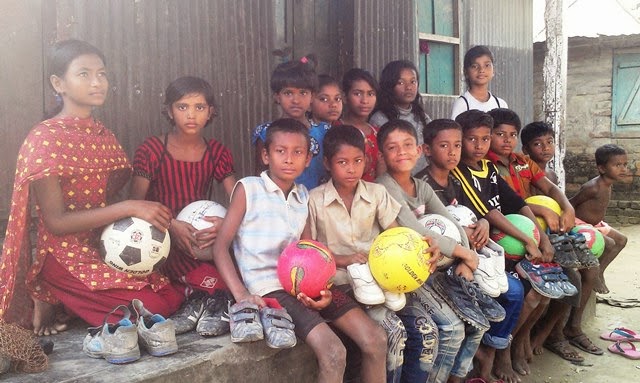
Living on the banks of the Gorai are some of Bangladesh's poorest families. It is from these families that Ahmed recruits the kids who are part of his academy. The parents of these children work as rickshaw pullers, tailors, daily wage labourers, fishmongers, janitors and painters.

Before joining his family business, Ahmed spent six years working as the Media and Communications Officer of the Bangladesh Football Federation and as a Regional Instructor for Football Administration and Management under FIFA. 

"I tried to use my football experience in rest of my life," he says. "Also, I wanted to do something which can bring good for people so [I] started [visiting] the poor area beside our office cum living space at Kushtia. 

"There I found no one playing any proper sport [on] their uneven field, so after observing for some days at their lifestyle, I went to the field with a football to encourage the older youth boys to play football as they couldn't afford a football," he adds.

Started in January 2013, Ahmed's project primarily targets boys and girls between seven and 13 years of age. Having no method to actually gauge how good the kids were, he would use running races to determine how speedy his potential trainees actually were.

Ahmed putting his charges through their paces. He uses the banks of the Gorai river for training them. Reproduced with permission.
"After some days, I announced that girls football will be organized, soon the sporting minded girls came out for play," says the 33-year-old. "After selecting some girls with good running ability, I went to their parents for motivating them to let [them] train with me. 

"Then I also [told] the parents that I [would] also take care of their education by giving them a personal study hour. Inspired by the girls learning the skills fast, I also started to add boys."

Ahmed says that the "main criteria for selecting kids are: poor kids but good at sports. I looked for various companies in the world who are all working in this sector [and] studied all the documents they published. Mainly, the Indian 'Magic Bus' concept inspired me a lot."

"We provide the poor kids with knowledge which are highly desirable benefits of a physically active lifestyle that contribute to competence in lifelong physical activities, attaining social and psychological life skills like interpersonal skills, resistance skills and improving developmental outcomes such as confidence, self-regulation, character, motivation, and perseverance," says Ahmed.

Logistics and training


Because of his association with the Bangladesh Football Federation, Ahmed is well aware that there are no football academies in his country. Football development schools that do exist are present only in name.

"For an academy, land, buildings [and] training facilities are a must," he says.

"The sandy riverside area is the main training facility and the training equipment are from various structures like abandoned half built bamboo house, cement blocks, staircases, cement slopes etc. which also reduces the cost of land, buildings [and] equipment," he explains. 

"All these are made by government and I can use it for free."

It is on these flats that Ahmed and his cousin teach these kids the art of performing stepovers, cuts and feints, as well as the more industrial elements of the game such as shooting, dribbling and tackling.

Because of his tenure in football administration, he has access to a large collection of DVDs which he uses to demonstrate skills to his potential graduates, in addition to performing them himself to show them how it is done.

Ahmed says he thought of developing his football academy in Kushtia after he found people who were enthusiastic about the sport. At first, they couldn't afford a football. Reproduced with permission
"A juice, a pack of biscuit, a boiled egg, and a banana is provided to each of the players after training which cost about $10 per day per head," Ahmed tells me.

"Sports shoes, boots, shorts, jerseys, sports bags, balls, guards etc. are provided step by step on overall progress of each player accordingly where one starts with bare foot and own gears without food. All this equipment is being earned/achieved by each player’s performances in each session.

"In the first month of training, a kid won't get any food or equipment but have to give me various tests to prove his stamina and strength both mentally and physically," explains Ahmed.

"Passing the first month, the kid will get new sports shoes for training. then passing the second month with regular presence in all of our activities she/he will get other equipment by showing progress in football training."

At present, it is his family business, Nandita Properties, that provides him with the funds he requires to procure the food and gear he provides these kids. He soon plans to convert this fledgeling set up into a non government organisation, which will allow him to seek funding from investors throughout the world.

Gaining recognition: his academy's proudest moment


One of the pupils Ahmed helped nurture is now playing for the Kushtia State Team. 13-year-old Nilufa Yeasmin, one of the first children he took into his fold, trained under him for six months before representing her school at a football tournament.

She was named the most skilful player of that tournament.

A month later, the district's selectors came calling. "She told me that there will be a selection at the district stadium, where her school wants to take for a football trial and again, I allowed her to go," says Ahmed.

"Then she got selected by the selectors of the district women footballers," he says.

"That was [the] greatest moment I'd ever enjoyed and [I] felt that my concept had started working," he exclaims.

"[The] reaction of the others at the camp was tremendous. They all became very excited and most importantly, [showed] their willingness to train for getting [into the] district team."


What comes next puts that into even greater perspective. Before the exploits of young Nilufa, Ahmed tells me he'd faced a lot of flak from different areas of society. 

'Why are you wasting your money and time after poor kids?,' they would ask. 'Hey look, a mad man is going who's spending his rich pockets' money,' they would say.

"I used to ask permission to each of the parents before involving the kids in my project. I used to motivate them, describe my purpose to develop the youth in a positive way," he recalls.

"I had to drop out some girls after some days of training for religious & social barriers. It took time [to gain] the confidence of the parents as it was an individual effort then."

That, however, is not the case any more.

"Later on, after project continued for [a] long time, then the parents started to believe in this concept," he continues.

"The parents in each month's feedback session informed [me] that the kids’ food habit increased, sleep time increased, study time increased, [they] became more active participants in their own families and social behaviour had been modified soon after they started training with us. 

"Nowadays, mostly poor girls [with potential] or mothers come to the training place and request [me] to include their kids too." I cannot help but smile as he tells me this.

In addition to just playing the sport, Ahmed makes it compulsory for his young players to devote time to study on a daily basis. Reproduced with permission
It's not just the parents of those he trains who feel this way. His own do too. "They are very excited and [have been] became [very] enthusiastic [about] my project from the very beginning," he says "They have always supported my dreams

"In this project my uncle is the main brainstormer for all success it already has (achieved)," he adds. "Now they have made a commitment to continue supporting this project at a reasonable scale for life."

Long-term plans


In 2014, Ahmed will apply to make his project a non government organisation, opening the doors to funding from various investors throughout the world.

"I will try to spread this concept countrywide through football federation or sports department of our government," he explains.

"After that, I want to make an ideal football academy to support the NGO."

Ahmed says he has good contacts with coaches in his country, so hiring them once he takes the next step in developing his academy will be easy. Because of his time in the administrative world of football, finding local sponsors will also not be a challenge for him.

He also aims to solve several problems that contribute to poverty by promoting an anti-drug attitude, increasing the living standard, empowering women and educating the poor society

"I involve other young kids in the afternoon at the field with various sporting activities which makes them tired," he says. "That prevents their tendency to go out in [the] evening or involve [themselves] in drugs has radically been decreased."

Training and academics aside, Ahmed is also teaching the children social responsibility. See here are the kids repainting sections of a wall. Reproduced with permission
"As the sports training takes out lots of energy, the eating habit of the kids, the habit of early rising and the sense of taking commands from superiors has been radically increased among the kids."          

He plans on improving youth participation in sports for positive development, increasing the standards of fitness and physical ability of youth from poor society and to increase the supply of standard football players specially women both locally & internationally.

"I will take eight years per player to build him/her as an international standard football player for sale to other countries or locally," says Ahmed. 

Ahmed believes in his vision. He also believes it will succeed. "Football is a universal language. All of the football stars in the world are from poor society and poor background. It changed their life," he says.

Related reading: Q&A with Chuck Martini, Head Coach, Muscat Football Academy

Monday, 25 November 2013

Sheffield University students protest visit of high-profile Israeli diplomat

About 30 students of the University of Sheffield's Palestinian Society protested against Israel's Deputy Ambassador to Britain when he visited the University on the 15th of November, 2013.

Alon Roth-Snir had come to Sheffield to give a talk to student's during the University's model United Nations summit at Firth Court but found himself on the receiving end of a protest that had been organised by the Palestinian Society just that morning.

File photo: Deputy Ambassador of Israel, seen on the right here, at a function hosted by the British-Israeli Chamber of Commerce. Image courtesy The Jewish Chronicle

Secretive


Originally, the visit of Mr. Roth-Snir had been kept under wraps in anticipation of such a protest, but this information was leaked to the Society that very morning.

Its members then tried via social media, phone and email to get as many people as possible to come down to Firth Court and protest against the ambassador 'justifying the existence of the Zionist State' according to Oliver Clay, a society member.

By the time Mr. Roth-Snir had arrived for his scheduled speech at 1:30 pm, students had already taken up positions in front of the building. 

"Four students were able to evade security guards and get into the same lecture theatre," says Oliver.

"The (society's) former president Abdi-Aziz Suleiman gave a speech in which he highlighted the crimes of the Zionist state in Gaza and the West Bank.

"Those who were unable to get inside gave a noisy demonstration outside which succeeded in repeatedly forcing the deputy ambassador to stop his speech," he added. "The chants could be clearly heard by the attendees inside.

"[We] also managed to build awareness of the occupation and hand out a great deal of literature to students and other passers-by."

The Deputy Ambassador was held up by protesters who were blocking his car's exit route on his way out of the premises.

Similar protests


This however is not the first time Mr. Roth-Snir has been faced with protests. Similar demonstrations were targeted at him when he had arranged to speak at both the University of York and the University of Essex.


Sam Rae, Sheffield University's Education Officer, had been in favour of the protests. Five days after the incident, a petition requesting a vote of no confidence was circulated, asking him to step down as Education Officer.

"Mr Rae humiliated not just himself, but the name of our University and I am ashamed to consider him a representative of my Students' Union,"  wrote Matt Brown, who proposed this petition. 

"I therefore call upon fellow Union members to sign this petition to mark their vote of no confidence in our Education Officer and to support a referendum to remove him from office," he continued.

The motion was voted against overwhelmingly.

The Palestinian Society in Sheffield was formed five years ago, and actively campaigns against the existence of Israel via film screenings, demonstrations and campaigns in favour of Boycotts, Divestment and Sanctions.

So far, says Oliver, the University has not sanctioned the students who took part in the demonstrations. In addition, he says the Society's actions have received an outpouring of praise from other campuses in Britain and on social media.

Related Reading: An Insight into the Life of a Student Protester